• Skip to primary navigation
  • Skip to main content
  • Skip to primary sidebar

Islamic Estate Planning Attorney

Islamic Inheritance

  • Home
  • About Ahmed Shaikh
  • Islamic Inheritance Calculator
  • Education
  • Contact Us
  • Blog
  • Show Search
Hide Search
You are here: Home / Blog

Blog

Hawthorne on Friday, TV on Sunday Insha Allah

December 12, 2019 By Ahmed Shaikh

I will be doing a presentation at the Islamic Center of Hawthorne on Islamic Inheritance and Islamic Estate Planning on December 13, 2019.  I will also cover some charitable planning.  If you or any friends or family are in the area, please send them over for the evening program.  I expect the program will be after Isha prayer but please contact the Masjid to be sure.

I am also going to be on the TV program Sada-e Haqon Sunday the 15that 11 AM.   It will be broadcast live and available on youtube and facebook.  This will also be about Islamic Inheritance.

When your Muslim Leader or Scholar is a Foreign Agent

November 15, 2019 By Ahmed Shaikh

Muslim Foreign Agents I recently wrote at MuslimMatters about the issue of Muslim leaders and scholars in the United States acting as unregistered foreign agents.  This is actually quite common and the fact that people are foreign agents is not in itself bad.  However, it could be very bad.

More important, there is a law, the Foreign Agents Registration Act, that requires detailed reporting that Muslim leaders and scholars never seem to do.  This is a crime could subject many of our favorite leaders and scholars to fines and time in prison.  You can read the article here.

New Workshop in Lomita

October 31, 2019 By Ahmed Shaikh

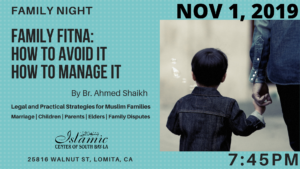
I will be doing a presentation in Lomita, California (in the Los Angeles area) on Friday night after Isha insha Allah.  It will be on practical steps to avoid fitna in your family.  I will go over many of the strategies in the book on Islamic Inheritance as well as on this website and MuslimMatters.

Many serious problems happen in very good families.  This can be elder abuse, problems with children, family businesses and, of course, inheritance.  It will include many of the issues discussed in our book and discussed on the website.  If you have friends or family that may be interested in the Masjid program, let them know.  If you want a presentation on this at your Masjid or gathering, let me know.

The Dilemma of the Widow

October 10, 2019 By Ahmed Shaikh

widow's dilemmaI have had several cases in the Muslim community involving widows over the years. In the United States, for the most part, by tradition and because the law and the way people tend to own real estate, everything tends to go to the surviving spouse, usually the widow (men tend to die sooner and marry younger women). This result often happens if you do something, like a will or a living trust that does not take into consideration Islamic Inheritance.

Here is a hypothetical scenario:  

Kinza is 38 with five children, ages 12 to 2. Her husband, Shakir, 43, just passed away from a stroke while lifting weights at a local gym. Shaker left behind his wife, children, and parents as heirs. Kinza and Shakir never did any estate planning together. They owned their home as joint tenancy with right of survivorship worth about $800,000 with a $300,000 mortgage. Kinza owns a part of an apartment building from an LLC her father had set up but has otherwise been a homemaker, with no source of income herself. She had a bank account jointly owned with her husband for about $30,000. Also, her husband had a 401(k) from his employment as an engineer worth $200,000, and Kinza is the sole beneficiary.  His employer also had life insurance as an employee benefit, which paid $150,000, again, to Kinza.  

Why the Widow Takes all

In some ways, Kinza, the widow, being the successor for everything makes sense, and would be the natural-sounding way things would work. There will be no probate under this scenario since Shakir left no probate property. Everything passed to Kinza. Kinza needs to do an affidavit of death to get the house in her name. For the bank account, share a copy of her husband’s death certificate, fill out a form, and Shakir’s name is off the account. For the life insurance and 401(k), she will provide a copy of her birth certificate and prove she is who she says she is. In the case of the 401(k), she will do a “spousal rollover” which allows for the account to be her IRA.  She would pay nothing on it until she starts her withdrawals, which by law won’t need to be for more than three decades. Her IRA is withdrawn based on her younger age, rather than her late husband’s older age, which is an advantage. 

One thing missing from all of this is what do the children get? What do the parents get?  Nothing. Kinza gets it all. This result is not satisfying for a few reasons. The first is that in Islam, there is a mandatory rule of inheritance in specified shares. The surviving spouse getting everything is expressly prohibited in the Quran.   

Now maybe it is the case that the surviving parents don’t care about their inheritance. They are elderly at this point, concerned about their grandchildren and daughter in law and will be willing to waive any right to inheritance. Inheritance is a right of the heirs; they can turn it down if they want. But then, what about the children?

The children are at this age too young to care about inheritance for themselves. They are orphans, however. Kinza needs to be concerned about the following verse in the Quran:

Quran 4:10

Indeed, those who devour the property of orphans unjustly are only consuming into their bellies fire. And they will be burned in a Blaze.

So this is pretty serious stuff. It does not matter that Kinza got everything from her husband; the Quran says she gets 1/8th from her husband. She cannot do an injustice to her children. She does consider the fact that she is taking care of her children.   Naturally, what she spends for her home, food and such, all benefits her children as well as herself. No lawyers or courts are involved here. It’s almost automatic. So maybe she is ok just taking everything, raising her children and not worrying about it?   

I would say it is a worry. It continues to be Kinza’s obligation to take care of her children. Of course, she is a parent to her children. There are legitimate expenses for the children for which Kinza may use a child’s inheritance.  However, Kinza needs to have some system in place of separating her wealth, and the wealth of the orphans, who are individuals and not a unit. Every one of her children gets a specific share. Allah ordained these shares in the Quran. So it makes sense for her to not be slipshod about it. 

It is easy for Kinza to squander everything, unintentionally. It happens quite frequently. I have had multiple woman clients who reported to me that they had married a husband that took all their inheritance. Kinza may end up marrying someone who turns out to be unscrupulous or otherwise corrupt with her (and her children’s) money. As the years go on, she may also get into a car accident, or someone could sue her. So she needs to not only make sure she is not the one doing an injustice to her children, but she is also guarding against injustice by others.

The Solution

The solutions here can vary. But California is a community property state. Kinza and her husband never had a property agreement themselves, so she did not know what her husband intended before she became a widow. However, given that she was a joint owner in everything and was a beneficiary, it is fair to say she was the 50% owner of all the property already. So she can safely say 50% is Kinza’s off the top, not as an inheritance, but because this was her own to start. Of course, if she divorced Shakir, instead of being Shakir’s widow, Kinza would get 50%.

The next thing she will do is divide up the inheritance. Say Shakir’s parents have waived the right to inheritance (which will never be a given, even if parents-in-law are spectacularly wealthy). She will need to create a way of cordoning off her assets from her children’s assets. 

Dividing it up

I wrote an article about planning with the family home for married couples, and if you are one, you should look at it.  Of course, Kinza as a widow has a different situation.

Kinza needs a place to live. Her husband was paying a mortgage on the home. So she either needs to start playing the mortgage, or she needs to move. There is equity in the house, and at least ½ of the ownership belonged to her husband. Similarly, ½ of the 401(k), ½ the life insurance (arguable) also belonged to her husband. Her portion of the rental property that her father gave her will remain her own.  

What Kinza will do depends on her plans for the future and the availability of resources and help. She has options here. In similar situations, I have created trusts, deeds of trusts, and business entities like limited liability companies.   All this depends on the kinds of assets involved. I would also develop systems that protect the inheritance of the orphans, usually through the trusts or business entities. We do this in service of Kinza’s knowledge that she needs to look out for the interests of orphans and not just the daily struggles of the widow. For someone who just lost her husband, who was the sole breadwinner, this is a great test.  

It is a test some Muslim women go through, being a widow.  It is especially bad when they never bothered to plan when married. Most people in this situation would keep everything. It’s easier, requires no lawyers, but with the downside that it is unjust. 

To avoid injustice to your family, make sure you have a plan and it’s up to date.


Nawabs are just the worst

September 20, 2019 By Ahmed Shaikh

Nawabs are the worst India is in the news in the United States, as Prime Minister Modi visits a post-flood Houston to the enthusiastic welcome of Indian Americans, including an Indian Muslim organization. This visit is all during the crushing oppression in places like Kashmir and other parts of India. It is not new or novel to see Indian Muslims fawning over oppressive leaders, as this has been going on for hundreds of years.  

History and law are interwoven and it is sometimes hard to know when one starts and the other begins. In India, legal cases take so long that when the courts resolve the case, it is about a distant historical event about long-dead litigants. Generations come and go before we know the answer to a fundamental question like, who gets an inheritance from a dead person? A recent case that lasted five decades before final resolution, in Modi’s India, on the side of Sharia.  

The issue was the estate of a princely statelet of Rampur, headed by a Nawab. Some descendants wanted distribution under Islamic Inheritance. Others expected a special dispensation allowing for injustice. The Indian court ruled Islamic Inheritance should be the system here. What’s left of a Nawab’s piddly empire is to be broken up.  

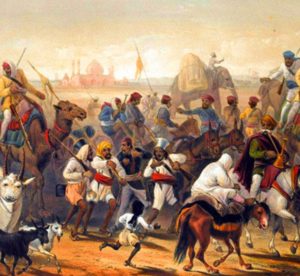
The wealth of the land was given to an individual family to perpetuate injustice. The Rampur Nawab sided with the British Raj during the rebellion of 1857. Those who stood with India instead of the British paid a massive price. Avoiding Islamic Inheritance was a way to allow injustice to continue. It was in litigation for decades. Now, it is over.  

Why we care about Nawabs

As you probably know, the British Empire ruled India for generations. This history was objectively devastating for most Indians, though it was great for a few, like the Nawabs of Rampur. In 1750, India, or more accurately the amalgamation of territories that later came to be known as India Pakistan and Bangladesh, was responsible for 25% of the world’s industrial output. By 1900, this figure had fallen to 2%. The British systematically robbed their possession; it’s people subjected to mass-murder, oppression, and even a manufactured famine killing millions.  

The British managed to do this without having to place millions of British troops to occupy the country. Indeed, they may not have had more than a few thousand most of the time. The British often left much of the oppression, theft, murder, and systematic barbarism to the capable hands of local leaders. Nawabs, like those of Rampur, held the favor of the Raj. This loyalty was also true of vast numbers of native Indian troops.  Indian soldiers were so loyal they were often used to oppress others throughout the British Empire (though there were notable heroic exceptions). Many of the Nawabs were Muslim.  

Oppression if you let it

The British knew that the best way to subjugate and oppress a population is to allow some people to benefit from oppression. Indeed, the world is full of Indians, including Indian Muslims, who see British rule as the golden age.

Now we have Indian Muslims seeing Modi as presiding over a new golden age. These Muslims will lavish praise on Modi’s Raj and trash-talk the Sharia to appease those who hate Muslims.

Nawabs are nothing unless they have large numbers of people enabling them, making them feel good about it. 

The worst oppression does not come from Modi, from the British, Soviets, Romans, or anyone else. The worse tyranny is the kind we do to ourselves and our own families and each other.  

Jabir ibn Abdullah reported: Muhammad (SWS), said, “Beware of committing oppression, for oppression will be darkness on the Day of Resurrection. Beware of greed, for greed destroyed those before you. It caused them to shed blood and to make lawful what is unlawful.” (Reported in Muslim)

Islamic Inheritance is a bulwark against oppression. It is fard, but it has a social function that is nothing short of priceless. Nawabs avoided the requirements of Islamic Inheritance to oppress more effectively on behalf of the Raj.  

Thanks to the new decision, their estates will be broken up.  

Nawabs still exist, and you don’t need to be an Indian-American to be one. You don’t even need to live under an empire or successor tyranny. Greed and corruption are everywhere. Do not let these maladies infect your own family and your community.  

To get a free Islamic Inheritance resource guide, including templates and comprehensive information on Islamic Estate Planning, click here.

  • « Go to Previous Page
  • Page 1
  • Interim pages omitted …
  • Page 13
  • Page 14
  • Page 15
  • Page 16
  • Page 17
  • Interim pages omitted …
  • Page 26
  • Go to Next Page »

Primary Sidebar

“Learn about the fara’id (Islamic Inheritance) and teach it to the people”- Hadith

Get our free Islamic Inheritance Resource Guide, including templates and the know-how you need to start protecting your family.

Download it now.

Recent Posts

  • What Is Baitul Maal, and Why Does It Receive Inheritance in Islam?
  • On Blogging Theology on Charity
  • Private Retirement Plans for Muslims: A California Legal Exemption Strategy
  • Free Loans for Muslim Family Members Have Secret Interest, Not Riba
  • Muslim Burial Challenges

© Ahmed Shaikh, Attorney at law. No legal services or advice provided without a written agreement.

  • Home
  • Islamic Estate Planning
  • Blog
  • Library
  • Contact Us