• Skip to primary navigation
  • Skip to main content
  • Skip to primary sidebar

Islamic Estate Planning Attorney

Islamic Inheritance

  • Home
  • About Ahmed Shaikh
  • Islamic Inheritance Calculator
  • Education
  • Contact Us
  • Blog
  • Show Search
Hide Search
You are here: Home / Blog

Blog

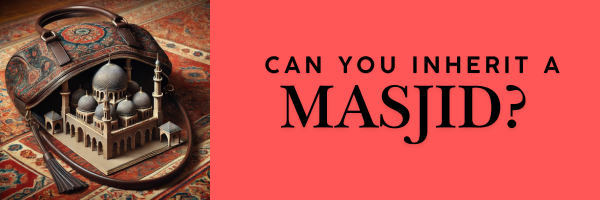
Can You Inherit A Masjid? (Why It May be Reasonable to Think So)

December 20, 2024 By Ahmed Shaikh


According to the case reporter, Imam Pasha Shaluddin was a pillar of his community and Masjid in Newark.  Imam Pasha founded a nonprofit religious corporation in 1988, the Islamic Center of Passaic.  He started the organization with no constitution or bylaws.  Imam Pasha had complete control.  Consolidated control, by the way, is typical of how some people have formed Masajid in the United States.  Someone starts it, runs it, and controls the whole thing. Completely normal. 

Imam Pasha’s community purchased a building in Patterson, New Jersey.  It was partially rented commercial space, the revenue from which would fund most of the Masjid on the same property.

Imam Pasha’s wife served as the Finance Director of the Islamic Center.  When Imam Pasha passed away in 2013, his wife, according to the appellate panel, “was under the mistaken impression she inherited Islamic Center and its property from her husband.” The wife “also appears to have believed she was vested with sole control of Islamic Center.” 

Why would she believe this? She may not have been unreasonable in thinking she controlled the organization.  The Masjid started as a personal fiefdom.  It was under the control of a husband and wife, where the husband controlled everything but the money, which was under the control of the wife.  For most people, absolute control is not anything different from ownership. 

Just like a country can be passed on from father to child, as is the case in many countries around the world, so can a farm, a house, or, it would seem, a Mosque.

In that case, another Imam and board created new bylaws, which were followed to remove the widow from her position. A trial court and appellate court agreed that the wife did not get the Masjid. 

The Fiefdom Masjid Model

Masajid with consolidated control is not uncommon in the Muslim community in the United States.  It works for a while.  Suppose someone has the support of other Muslims in the community or the resources themselves. In that case, they can start a Masjid, raise money, draw a salary, and not worry about “accountability” or people asking “questions” about how he runs the organization, his decision-making process.   

This model is also relatively standard in the United States for other faith traditions. 

Muslim organizations do not have political protection and are subject to tax laws that are perhaps not as enforced in some communities but could have some harsh results if they were.  The fiefdom model can be a horrible idea. 

The Private Inurement and Private Benefit Doctrines

A religious organization must operate exclusively for religious and charitable purposes.  Any private benefit can jeopardize the organization’s tax status.  Control by a person or family would be a massive red flag.  Occasionally, masjid property may be owned directly by the person controlling the Masjid, but donations would flow to a nonprofit organization. 

This issue concerns private inurement and private benefit, which are related but somewhat distinct concepts.  Private inurement is an absolute bar that prohibits people from taking undue advantage of a nonprofit in a way that is not identical to ordinary business practices.  So, for example, if giving the Masjid property to the person who runs the Masjid is just a deal for the guy who runs the Masjid, it would be pretty suspect. There are taxes on what are known as “excess benefit transactions” in IRC 4958. 

The Private Benefit Doctrine differs slightly, but courts have blended it with private inurement.  The concept can go beyond monetary gain, and suspect benefits can go to more people than insiders but benefit a limited number of people. 

Both private benefit and inurement can also harm the organization and the person who runs it.   

Muslims Have Been Fortunate

There is a strong tendency by mostly smaller Muslim organizations to be run as private for-profit businesses. That we are dealing with a “business” has implications for expected Islamic inheritance.  Family members may naturally expect to inherit from a nonprofit organization, which is technically supposed to be for charitable purposes and has no owners.  So, family members may end up disappointed because while they may naturally expect it because of the specific nonprofit culture, that is not how nonprofits work.  Beyond this, though, there is the potential for more significant losses if the IRS becomes interested in what is happening.  So far, they have not been.

As we transition to a new federal administration, it may be time to look at whether Muslim organizations and the people running them are vulnerable to enforcement of tax laws.  

For a consultation with Ahmed Shaikh regarding your Islamic Estate Planning, you can schedule a 15-minute meeting on zoom by clicking here.


Muslim Trustees Stealing Inheritance and How to Stop it (maybe)

October 4, 2024 By Ahmed Shaikh

Stealing Inheritance among Muslims

Orphans and stealing inheritance in the Quran and Islamic estate planning

Indeed, those who unjustly consume orphans’ wealth ˹in fact˺ consume nothing but fire into their bellies. And they will be burned in a blazing Hell! – Quran 4:10


Stealing Inheritance Has a Long Tradition

This is a verse of the Quran, 4:10, that immediately precedes the verses on Islamic Inheritance. It is a recognition that people do steal from orphans. The thing is, it’s possible to get your Islamic Estate Plan right but have someone you trusted steal it after you die.  It happens all the time.   Often, these are not just random people, they are not merely unscrupulous orphanage administrators. Sometimes, they are uncles, the surviving parent, stepparents and others who have guardianship of an orphan.  Precisely the people who are in a position of trust.

One of the weaknesses with any estate planning is that we are dealing with human beings. People can be fickle, their personalities can change, their circumstances can change, or, the trust that someone placed in them was misplaced for years and the folks who trusted either had no idea or wanted to have no idea.

This is the thing about trust;  it is essential to a functioning society. We trust mothers, we trust fathers, children grandparents and others in our family. Going beyond that, people trust their school systems, their banks, their employers, their government, customers and on and on. We need to do that, that is how society works. Even so, we all know that governments often violate the trust of the governed, children let their parents down all the time, as do teachers and just about everybody else at some point or another.

How does this fit in with the trust?

The thing about doing a revocable trust, is that the distribution of the trust of the various beneficiaries happens after you pass away. You are going to pass away at some indeterminate point in the future. Sitting here right now, reading this, you have no idea what the circumstances of the world will be like when you leave it. You do not know who is rich, who is poor, who has a gambling problem, a drug problem, what religion anybody is, who they are married to, or if the people around you right now are living or dead.

You do have some advantages here though. While you are alive, and healthy, you do know what the circumstances of the people around you are like, for the most part. Sometimes your family members are keeping secrets from you.

Understanding your responsibilities in selecting a trustee or other fiduciary

Often, people with adult children will often select the eldest child as their first choice of a successor trustee, even if there may be misgivings among other family members over this choice. This is often because they do not want to offend the eldest child, given that there is a   ranking system among children within families that has to do with birth order.  Other times, people’s will select family members based on how successful they are, how successful their marriage appears to be, physical proximity to the parents or other considerations.

In some families, it’s not the children, but the daughter-in-law or the son-in-law that would be the most trusted and reliable.

None of these things are necessarily bad or wrong in themselves- that is how things go in families.  There can be problems though.

Who has influence over the parents

Sibling rivalries often figure prominently in Estate Planning.  Muslims are quite fortunate in that there is a uniform system of inheritance.  Parents don’t get to pick the share of inheritance or determine who is more deserving among children.   There is however, a difference between “Estate Planning”- which is how assets are organized, and include a complex array of gifting, tax planning, business planning and asset protection systems, and “inheritance”-which is what successors get from a deceased person when that deceased person cannot take things with him or her (which is every deceased person, to be clear).

In certain types of estate planning, parents may have very different relationships with different children. Those include the following:

  1. Business relationships

There may be controversies among family members about how much a child who is in the family business actually contributed to that business. A child who works in the business may actually consider themselves to have earned “sweat equity” and may take over the business in ways that might increase tensions among others in the family. Siblings were not involved in the business may not feel that there was any sweat equity at all and that the child in the business was little more than an entitled ne’er-do-well collecting an allowance though adulthood while pretending to be a business tycoon at their father’s company.

When it comes to family business planning, keeping the peace within the family over the long term is often a vexing goal for parents. More than that, because there are often going to be allegations of “undue influence” between the child that is in the business and children that are not in the business, it’s going to be important how much you “privilege” one child over another.

Children were not involved in the business are often going to feel like there inheritance was stolen from them. They may all live in different realities about what happened throughout the rest of their lives.


  1. The failure to launch


This is a scenario where one child continues to stay with the parents, never really has steady employment and perhaps never gets married. As the years go on, this child starts taking over virtually all financial responsibilities for the parents. Other siblings might see the situation differently.

  1. Was it a loan?

One of the more common scenarios is intrafamily loans. Parents may loan certain children far more since some children are more successful than others. Loans can be for failed startups, real estate or, just to provide some needed cash at the right time.  These things may not be loans at all, but could be gifts from parents. That is also known to happen.

The problem is children may not actually know what it was. If one child was the beneficiary of largess from a parent that another child was not, often the parent will not be blamed. The sibling who was the beneficiary of this largess will often be accused of stealing, or some sort of elder abuse. Not paying back a loan by re-characterizing it as a gift when it was not a gift would be stealing.

The problem is, the vast majority of the time, loans are not documented within families. The people who gave the loan or gift, are typically not available to tell anybody what it was. Different siblings might have different stories about what the parents told them.

Of course, writing all of this down is vital, and something advised in the Quran.

Managing conflicts of interest

In a variety of situations, including the ones I mentioned above, there are conflicts of interest when it comes to children acting as trustees for their parents. Among the responsibilities of the trustee, for example, is managing a business or collecting debts. These are some of the biggest controversies in managing estates.  Siblings may be caught in the middle of them.   Managing conflicts of interest poorly is often indistinguishable from stealing inheritance for some people.

Personal failings

Sometimes beneficiaries can play fast and loose with ethics. They may “borrow” funds, live in a house indefinitely when they should be selling it or paying themselves unduly generously in salaries or other perks.

Then there are other things that I mentioned above, such as the gambling issue.  Oftentimes, desperation will lead people to feel stealing inheritance from family members is okay.

Use of professional fiduciaries

A professional fiduciary is one of the more valuable and underutilized tools in estate planning. For the most part, many families would rather not pay a third party to manage their finances in the event of death or incapacity. They would rather lean on their children or other family members if possible. And in fact, family members would rather do this as well. That is what family does, they step up when there are problems, right?

Professional fiduciaries can sometimes solve significant problems.  Much of this has to do with uncertainty.  Time will change facts when it comes to your family and the circumstances of it’s members.

I am not going to pretend that time does not affect professional fiduciaries or that these people are never going to be stealing anyone’s inheritance, the same as family members stealing inheritance.  What I can say though, is that unlike family members, professional fiduciaries tend to be professionally licensed, bonded and insured.  Many have billions in assets (though some are mom and pop operations that are still bonded and insured).  Think of this as a bank.  Bank employees steal from the banks they work at all the time.  You know this.  And yet, we all keep putting our money in the bank.  We know the money is insured.

Another advantage is family unity.  Someone upset with a Trustee over something is upset at an outsider, not a brother or sister.  The family members can oversee the Trustee’s operations and make sure the Trustee is doing a comprehensive and professional job.  It’s awkward and uncomfortable to look over the shoulder of a family member Trustee.  Most people won’t do it.  Before anyone notices the money is gone, it would be too late.

A Blessing, But We Still Have People

The Islamic Rules of Inheritance is a blessing from Allah.  It makes life easier for families because of uniformity when it comes to shares of inheritance that are not based on your vanity and how you think things should be.

However, this does not stop Muslims from stealing inheritance from their family.  Not much in the world happens without trust and you should trust people that have earned it.  One thing you should not do though, especially in your Islamic Estate Planning, is trust that everything will always be the same.  It won’t.

Subscribe to our newsletter here.

To schedule a 15-minute no-obligation zoom call with Islamic Estate Planning Attorney Ahmed Shaikh, click here.

The Power of Attorney in Islamic Estate Planning

August 25, 2024 By Ahmed Shaikh

The Power of Attorney is a big part of the “Big Four” set of Estate Planning documents

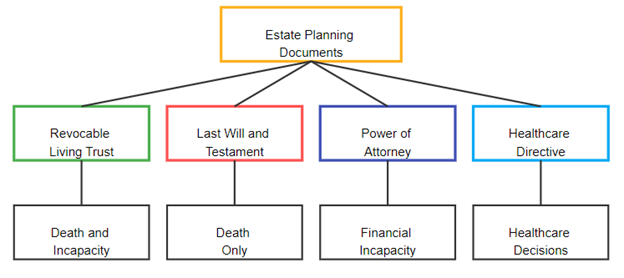
The “Power of Attorney” is a vital part of the “stack” of estate planning documents commonly provided by attorneys when completing an overall estate plan. While estate planning documents can include a wide range of things, the most common are as follows:

Estate Planning big four documents, including Power of Attorney

There are many other estate planning documents. However, these are the “big four.” The Revocable Living Trust is the backbone of any estate plan. It deals with the question of what happens in the event of both death and incapacity.   For Muslims, it is vital that this contains provisions for the Islamic Rules of Inheritance and the Wasiyyah.

The Last Will and Testament, deals only with what happens after death.  This is a backup document, but it is coordinated with the Islamic Inheritance plan, specified in the living trust.  The healthcare directive deals with what happens if a person cannot make healthcare decisions for themselves.

The Power of Attorney (often called a POA) deals with what happens in the event of incapacity, but not always. In fact, we often don’t even associate it necessarily with incapacity.  Traditionally, A “Power of Attorney” has no effect once the “principal” (the person who signs the power of attorney) is financially incapacitated.  That is not the kind of Power of Attorney estate planning attorneys use when preparing an estate plan, since estate planning is often concerned with “what if” scenarios.


What Power of Attorney does

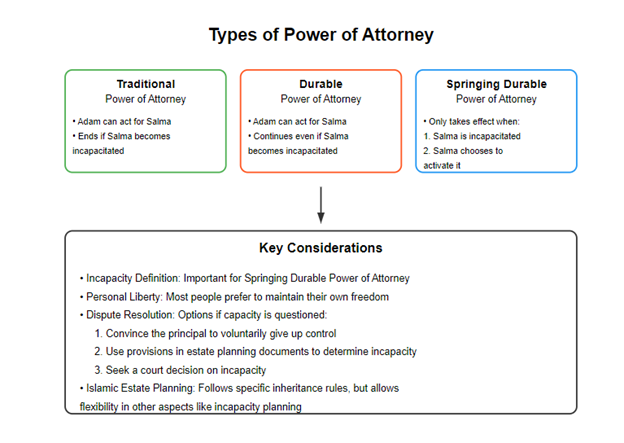
Traditional Power of Attorney

Salma is a successful children’s book author. She gets revenue from a variety of sources, movies, music, touring, endorsements and the like. Her husband Adam is her  business manager.  Salma trusts Adam to manage all her financial affairs. She signed the Power of Attorney allowing Adam to invest her money and pursue various business deals as Adam sees fit so that Salma can focus on her creativity child-rearing, and lifestyle without worrying about her day-to-day financial affairs. Salma grants Adam a Power of Attorney, where Adam manages her financial affairs, periodically consulting with Salma.

However, for nearly everything, Adam has the power to sign Salma’s name as her agent under the power of attorney. In this case, Salma is the “principal” and Adam is the “agent.”  The “agent” is sometimes also referred to as a “attorney-in-fact.”

In a traditional Power of Attorney, if Salma were to become financially incapacitated, Adam can no longer make financial decisions for Salma.

Types of Powers of Attorney

Durable Power of Attorney

Salma has the exact same relationship with Adam. However, if Salma is financially incapacitated, Adam can continue signing for Salma. We call this a “Durable Power Of Attorney.”  If Salma were to become comatose for an extended period, develop dementia or have some other calamity or life circumstance that prevents Salma from maintaining his executive decision-making ability, Adam can simply go on and make decisions for him.

Springing Durable Power of Attorney

Salma and Adam do their estate planning.  Salma sets up her plan so that Adam does not immediately have the power to sign Salma’s name even though she made him her agent in this document. This is because she signed something called an “Springing Durable Power Of Attorney.”

A Springing Durable Power of Attorney is one of the more common devices used by estate planning attorneys. It only comes into effect if a “spring” is sprung. That spring can exist in the revocable living trust, or in the Power of Attorney itself. The spring occurs only if:

  1. Salma is incapacitated.
  2. Salma decides she wants to give Adam all of her authority regardless of his incapacity.

Definition of Incapacity

Most people prefer they maintain their own liberty and freedom and not simply headed over to another individual.  People like freedom and personal liberty.  There may be business or practical reasons to hand somebody Power of Attorney right now.  Many people would be completely fine handing over that authority the other spouse immediately. Indeed, some estate planning attorneys prefer doing this.

But in the event that we have a “Springing Durable Power of Attorney” there needs to be a way to define incapacity. In general, people create incapacity provisions in a revocable living trust and a Power of Attorney document to avoid a conservatorship. A conservatorship is a judge supervised process to deal with allegations of loss of capacity and managing the affairs of those who have been adjudged to have lost that capacity. It is often a difficult system for families.

One of the major reasons to do an estate plan with an attorney is to maintain dignity and privacy for families during their more difficult periods.

Disputes over Capacity

Say Salma, from our earlier example, is making some pretty bad financial decisions. She is hanging out with a new group of friends, somewhat younger than her, that appear to be exploiting her financially. Adam, her husband, becomes alarmed and wants to do something about it. His children, who are adults now, are similarly alarmed.

Salma, in this situation, seems completely normal.  She is intelligent, funny and more than capable of dispensing wisdom. She does not believe she is being financially exploited and enjoys the company of these new friends.

They have a few options in this situation

  1. They can convince Salma that she has lost financial capacity and agree to sign a document that gives Adam power over his affairs so that this financial exploitation can stop.
  2. If the estate planning documents contain a provision to determine incapacity, which could include the use of medical doctors or a panel of family members or others that can decide the issue of incapacity privately, they may go about doing that.
  3. They can get a court to decide on Salma’s incapacity against his will.

Peace of Mind

Estate planning documents are the byproduct of a process and not merely a thing you sign.  For Islamic Estate Planning, there is no leeway in how much one heir gets versus another heir.  That is ordained in Islam.  However, you have a massive amount of leeway when it comes to other aspects of your planning.  That includes incapacity planning.

What one person is comfortable with may not be the same as what another person, including a spouse, may be comfortable with.  It is vital to have a conversation about these things before signing anything.

Don’t take the Power of Attorney lightly.


To discuss Islamic Estate Planning with Attorney Ahmed Shaikh, you can schedule a 15-minute Zoom call by clicking here.


The “Golden Child” Problem in Islamic Estate Planning

June 10, 2024 By Ahmed Shaikh

The Golden Child and Islamic Estate Planning

Start with a Goal

A “golden child” is a problem that can upend the plans of parents with the best of intentions. So let’s work this out.

Anytime we talk about things that have to do with estate planning it is important to start with goals. One of the great things about doing estate planning based on the Islamic rules of inheritance is that I am dealing with Muslims who tend to have the same goals.

When it comes to gifting though, that is not inheritance. Parents have significantly more leeway to distribute gifts to adult children. It is relatively frequent that parents will decide that they are going to give more to one child versus another. The reasons may be varied but they come down to the following:

Tuition

In the case of college tuition, it may be that one child goes to an expensive private university while another goes to a relatively inexpensive public institution, maybe does not go to college at all. This will result in one child getting a benefit from their parents that may be in the hundreds of thousands of dollars (this is common for professional education, like medical school) while another child may get none of this.  While it some cases this may contribute to resentment, it’s usually not as big a of a problem in families.

Economic Disparity

There is a substantial economic disparity between children. One child is remarkably successful while the other is not successful at all. The child who is not financially successful will often be showered with gifts, including real estate and what might amount to an allowance that never seems to stop. Other children might work for a living. They might find the arrangement with the less financially successful child a source of resentment.

The Family Business

A child might be more privileged on account of their closer association with the parents because that child runs the family business. This may not be gifts given, per se, but it may sure seem that way. An adult child that works at their father or mother’s company may get benefits and titles unavailable to other employees. It may also not be clear to other children outside of the company if the child is contributing to the success of the company or if the child is effectively just getting an allowance.

In social science this person is called “the golden child,” and often this individual might have an oversized perception of their own contributions to both the family and the company. Sometimes, we have seen situations where the child wants to extract all the value of the business for themselves to the exclusion of the other children. As a result, the “gift” to the golden child can be quite spectacular.

Being at home or close to home

Like the situation with parents involving a child in the business, is when parents start to become more dependent on specific children. Sometimes, the person that the parent has become dependent on is not the child at all, but a daughter-in-law or son-in-law. In very extreme cases, the child may serve to restrict access by other children, often making it uncomfortable for other family members who do not live with their parents to even visit with their parents. The distance between parents and children can grow over the years and result in increasing financial benefits to the child who stays at home or close to home. Sometimes, this can border on or become financial elder abuse.

Addressing the “golden child” family dynamic

One of the greatest forms of wealth that you can potentially give to your families is not monetary. It is social capital. The best form of social capital is that you have children who are close to each other, they have their own children who also get to know each other and can bond with each other and be a benefit to one another. Anything that you as a parent might do when it comes to financial benefits received by one child that is not also given to another child potentially be harmful to your family’s social capital.

We all know that it is prohibited in its to cut family ties. We should also do whatever it is that we can to make sure we are not doing anything that encourages cutting a family ties, like causing needless sibling conflict by effectively anointing someone as the golden child.

So how can we avoid the “golden child” problem?

Have a mission statement.


This might sound a little bit corny; you should seriously consider how you plan to utilize your wealth as you grow older. You do want it for yourself with, so that you can travel, enjoy life, and sustain yourself for the rest of your years. You also want to give to charity, and most importantly, you do want to help your children if they need that help.

This mission statement would become a lot more vital as guiding principles for things such as business succession, charitable giving, and your plan for growing older, which has some fairly unpleasant but relatively frequent problems as such as potentially needing more help with things, with the understanding that you may lean on some children more than others.

Transparency

Family meetings can be incredibly helpful. Your adult children should know what your plans are with respect to your wealth, how you hope to help each of them whenever it is that they need that help.

Siblings are often very understanding about why it is that one of their siblings needs extra assistance. There is often the difference though between helping someone get back on their feet and a grown man living on an allowance provided by their parents when he is perfectly capable of getting a job. If you have a child with special needs, children will of course be very understanding and may contribute to help their sibling themselves.

Do not think of your wealth is being your wealth, do not think of it as being your family’s wealth either. It is neither of those things. Wealth is entrusted to you by Allah.

To Allah belongs what is in the heavens and what is in the earth, and Allah is enough to trust in.

Your wealth can be used to support peace and harmony over the long term within your family or it can be used to promote harm. Often, especially with wealthier families, parents often use wealth, unwittingly, to promote long-term harm among children.

Was it a gift or a loan?

Make your intra-family financial arrangements clear. Will anyone know if it was a gift or loan, after you died?

Example:

Sulaiman 35, $750,000 from his father, Yasin, 75, towards the purchase of a home. This constitutes about half of Yasin’s wealth. Yasin, tells his daughter Asma about this, and says “Sulaiman will pay me back when he gets a promotion.”  Sulaiman and Yasin never have a written agreement. Yasin dies 2 years later. Asma asks him about the loan, and Sulaiman tells her it was not a loan but a gift because he did so much to help his parents while Asma allegedly did nothing. This results in long-term resentment between Sulaiman and Asma.

The solution in such cases is obvious, write it down. The fact that you make a loan within the family is not less of a reason to document the transaction, it is more of a reason.

Business Succession Planning

it is vital to look at business succession planning in a way that is fair to all children, including those not in the business. It is normal for parents to be disappointed when they have children who do not want to be involved This process should leave that aside.

If you are fortunate enough to build a successful business, the goal of handing it off to children can at times seem a bit myopic. Children who are involved with the business might make unreasonable demands that parents are willing to fulfill, just to have the children continue to be involved. They often feel like they have leverage over their parents, which seems strange but it’s true. It may not matter that the children are not especially good at management or capable of growing the business.

Sometimes, there is nothing wrong with having a business succession plan that does not involve giving the top job to your child, at least not right away. You want to make sure that you are running your family business in a way that is most beneficial to your family. Sometimes, this means not giving “golden child” status to a particular child. This is true even if the child has put many years into the business.

In this case, you need to go back to your mission statement. Is your mission statement say anything about privileging a golden child to the exclusion of other children? Probably not.

Putting it all together in an Islamic Estate Plan.

An Islamic Estate Plan can often have to do with more than just the Islamic Rules of Inheritance. It may be a plan for healthcare decisions, communication, transparency, business succession and incapacity. The most vital component of this plan though is to maintain peace.

To discuss your Islamic Estate Planning, you can schedule a no-obligation meeting with Ahmed Shaikh on Zoom by clicking here.

What is an Islamic Trust?

June 6, 2024 By Ahmed Shaikh

Islamic Trust

When someone uses the term “Islamic Trust,” it could mean one of several things.  However it usually just means a trust where hopefully nothing haram (prohibited in Islam) is going on.  A “trust” is a relationship; it is not a piece of paper, though often a byproduct of that relationship is pieces of paper.  

Example: 

Abdullah travels to Africa for three months. He then asks his best friend, Haroon, to take care of his pet anaconda, Isabella. They write nothing down, but  Abdullah and Haroon have nevertheless created a trust.  


This basic concept leads us to use trusts with an Islamic Estate Planning Attorney. Trusts are never oral, but the idea of having your affairs managed in the event of death, incapacity, or for other purposes is the same. An “Islamic Trust” can be used for a few different purposes. 

Implementing the Islamic Rules of Inheritance


Islamic Inheritance is fard for Muslims. I have a comprehensive article you can read about here. However, a trust as part of an individual’s Islamic Estate Planning includes a “living trust,” a will, a power of attorney (for incapacity planning), and other documents. 

Waqf

A Waqf is a trust, but the context of the term and its use is far different from planning for Inheritance.  Contrary to popular belief, a “waqf” is not the same as charity. A masjid or a school can be a waqf, but many Masjid and school founders did not organize it that way.  A waqf has a perpetual existence.  However, it may be for the benefit of a family, the Muslim community, the community at large, or animals (like a nature preserve).  Of course, like anything else, the thing that makes it “Islamic” is that it is not prohibited in Islam and is hopefully beneficial.  

Charitable Trusts

A charitable trust is not necessarily a waqf.  There are a variety of such trusts, including charitable remainder trusts, charitable lead trusts, and other trusts with philanthropic components.  An Attorney who is an expert in Islamic Estate Planning would need to structure such trusts so they don’t violate various Islamic rules.  Learn more about it here. 

Other purposes

Trusts are contracts. As such, they can be used for a wide range of purposes.  For example, including business succession, public benefits planning, asset protection, tax planning, and more.  

If you need an Islamic Estate Planning attorney to help you form an Islamic Trust, whatever form that may take, you can schedule a 15-minute no-obligation Zoom call here.  

  • « Go to Previous Page
  • Page 1
  • Page 2
  • Page 3
  • Page 4
  • Interim pages omitted …
  • Page 26
  • Go to Next Page »

Primary Sidebar

“Learn about the fara’id (Islamic Inheritance) and teach it to the people”- Hadith

Get our free Islamic Inheritance Resource Guide, including templates and the know-how you need to start protecting your family.

Download it now.

Recent Posts

  • What Is Baitul Maal, and Why Does It Receive Inheritance in Islam?
  • On Blogging Theology on Charity
  • Private Retirement Plans for Muslims: A California Legal Exemption Strategy
  • Free Loans for Muslim Family Members Have Secret Interest, Not Riba
  • Muslim Burial Challenges

© Ahmed Shaikh, Attorney at law. No legal services or advice provided without a written agreement.

  • Home
  • Islamic Estate Planning
  • Blog
  • Library
  • Contact Us