• Skip to primary navigation
  • Skip to main content
  • Skip to primary sidebar

Islamic Estate Planning Attorney

Islamic Inheritance

  • Home
  • About Ahmed Shaikh
  • Islamic Inheritance Calculator
  • Education
  • Contact Us
  • Blog
  • Show Search
Hide Search
You are here: Home / Blog

Blog

Six End of the Year Charity Tips

November 20, 2022 By Ahmed Shaikh

Charity

Despite the poor stock market, some readers have had a good enough year where they are looking at year-end giving to charity. While this is a blog post, you should investigate more before deciding if a strategy will work for you. Here are some ideas you may consider:

  1. Income from an IRA you don’t need and don’t want to be taxed on can go to charity

This helpful reminder comes from the IRS. You can make tax-free distributions of up to $100,000 per person from your IRA if you are more than 70 ½ years old. This kind of distribution is not an option for reducing people’s tax burden now for income already received, but it is a great planning tool for future years. For example:

Bilal is 73 years old and retired with a high income from his pension, rental income, and IRA. His IRA income comes from a “mandatory minimum distribution” he does not need, but the government forces him to withdraw some of it yearly because that’s how IRAs work.

Bilal can give up to $100,000 of this IRA income to charity. He cannot deduct the donations from his taxes, but it does count against the mandatory minimum distributions, so he has that much less income. The government does not force Bilal to take the distribution, pay taxes, and give it to charity. I am describing a Qualified Charitable Distribution (QCD), and you can read about it here.

  1. Cash gifts tend to be inefficient.

The value of your deduction is your donation times your highest marginal tax rate. So, if Bilal donates $100 to charity and has a marginal tax rate of 35%, he saves $35. However, suppose Bilal donated $100 in appreciated stock purchased for $10. In that case, that is a savings of having to pay income tax on the $90 appreciation, plus he gets the deduction for the complete donation. That is just the start. It would help if you generally planned charitable gifting, the who, why, and how.

  1. Huge income years may have a charitable solution.

Many people have years where they receive a significant income they usually don’t expect yearly. For example, on the sale of a business, or a building, certain kinds of lawsuit judgments and a big bonus can result in a rather extreme uptick in income for a specific year and, thus, a more significant than the ordinary income tax bill. It’s possible to get a tax deduction for giving to a charity that year for an amount substantially more significant than the charitable gift for that year; this is through a charitable lead trust.

Example:  Bilquis owns restricted stock in a startup she works at. Someone purchased the company, and her HR tells her she will receive a taxable income of 2.3 million dollars. Bilquis knows payments like this are unusual, and she would like to keep as much money as possible for her family, retirement, and other priorities.

She creates a “charitable lead trust” (CLT) that allows her to give a percentage of the $2.3 million while investing it every year for the next 20 years. She can spread her deduction for the next five years.

Bilquis could get a deduction with a CLT trust, like an outright donation. With a CLT, Bilquis gets to keep nearly all the money. Twenty years later, she may have much more if she invests wisely while donating.

  1. Some charitable-tax planning increases income.

One of the more common charitable planning techniques, a “charitable remainder trust,” is a kind of “split-interest trust” where the person who creates a trust gets several tax benefits. The result may still be more taxation overall, but because there is more to tax.

For example:

Hamza sells an office building owned by his charitable remainder trust for a profit of $4 million.

He is not immediately taxed on the capital gain of nearly $4,000,000 and can reinvest whatever he wants, supercharging his returns.

Hamza also gets an immediate tax deduction. It’s for the value of the future interest in charity.

Income from the trust that goes to Hamza is taxed but on more favorable terms than other investments. When setting up the trust, Hamza has various options regarding when he starts to take distributions and under what terms (there are a detailed set of rules, however). He can decide to take a “unitrust” – say 6% of the account value, an annuity trust, which is fixed income (but it’s not interest), net income, or a variety of other options.

The entire trust ends up going to charity eventually. That’s the bargain with this kind of trust. An illustration can show people who invest through charitable remainder trusts can do substantially better financially than those not having such plans.

  1. A Charitable Gift Annuity is a horrible idea.

Many nonprofits will try to sell donors, especially the elderly, something called a “Charitable Gift Annuity.”  It works like this:


Khadija is 80 years old. A local nonprofit offers her a charitable gift annuity. It’s a way to earn a fixed income, guaranteed by an organization’s assets for the rest of her life. She decides to donate $3 million, which will generate a guaranteed $120,000 per year for the rest of her life. Khadija figures she can retire and not worry about the stock market. She will get a tax deduction for the value of the charitable contribution.

Annuities are often a bad deal and are often exploitative to the elderly. They are not as safe as you might think. This device likely violates rules on Islamic Inheritance as well as interest. As we are dealing with nonprofits, consumer protections in the law often melt away, but they are the same product.

Please stay away from them and discourage Muslim organizations from marketing them.

  1. Always Research Charities

The charitable sector has many organizations that do good work. The industry is lightly (if at all) regulated by state and federal governments and has tended to attract more than its fair share of corrupt operators. Religious nonprofits are the least regulated by design and tend to have almost no accountability.

Having social ties to an organization, hearing a good speech at a fundraiser, or being subjected to brand advertising is not a substitute for due diligence. Organizations often figure you would be less careful about the money you give than what you invest for your family. They may be correct, but why should that be?

You should care about the money you spend for the benefit of your brother just as much as you care about the money you keep for yourself. As Muhammad (sws) is reported to have said, “none of you will believe until you love for your brother what you love for yourself.”

Charity is more than just a tax benefit. It’s an act of love.

You can read my Muslim guide to charitable planning here. To discuss the process for charitable trust planning or Islamic Estate Planning, you can schedule a 15-minute zoom consultation here.


Islamic Inheritance for all the pronouns

November 14, 2022 By Ahmed Shaikh

Pronouns Islamic Inheritance

Pronouns, Gender and Estate Planning

Pronouns came up recently when I was listening to a continuing legal education program on estate planning. I need to do regularly to keep my license to practice law.  A presenter advised estate planning lawyers should stop identifying children as “sons” and “daughters” in estate planning documents.

We should make all estate planning gender neutral.  

The reason estate planning lawyers should move away from this terminology, we were told, is that these things are always in flux.  A daughter may end up becoming a son, then switch to “non-binary” after the estate planning is done. Family members may switch back and forth or in a variety of other directions. Our documents should not put people in outmoded and arbitrary boxes like “man” or “woman.”  

Where Society is on Gender and Pronouns

Conventional wisdom throughout much of the United States, enforced now through the medical, public education, mental health, government, and legal worlds, is that we as a society should encourage people to change their genders and encourage everyone to “live their truth.”  Changing genders, or reimagining what that means, is proposed as a solution of a wide range of problems, the most common we are told, is that it somehow prevents suicide.  

One of my clients told me about the Islamic School his child was in, where two Muslim middle school girls decided they were no longer girls.  One Muslim elected official in Oklahoma identifies as “nonbinary,” identifying as she/they.    This means she claims to be neither a man, nor a woman.  

There has been much written on if this kind of thing is good or bad, and it’s not my purpose to do either.  Rather, I want to address the Islamic Estate Planning implications for families who identify as genderqueer, trans, non-binary or who have adopted or created a new gender from a list, or just made up a gender.  

Some people reading this, especially Muslims, who have an Islamically-informed worldview, there are some clear rules, and a bunch of what is happening in our society is impermissible in Islam. People in Muslim families are changing their gender identity and expression.  We need to deal with that in a variety of ways, as families and as a society. 

Islamic Inheritance Consequences with Pronouns

 Daughters and sons get different shares of inheritance in Islam, something I have written about extensively.  A daughter deciding, she is a son, and her family’s affirmation of this, payments for hormones and surgeries and flying the trans flag outside the house won’t change this, biological sex at birth will be the correct share of inheritance.   

 Muslims do things that are impermissible in Islam all the time, it does not change the shares of inheritance.  Changing your “gender” is not the same thing as leaving Islam.  Disinheritance on this basis is out of the question.  

Islamic Estate Planning and Islamic Inheritance are not the same thing

As I often tell my clients, “Inheritance”- as in the shares of Islamic inheritance – is different from “Islamic Estate Planning”- which is about organizing your assets during your life for the purpose of fulfilling a variety of goals (charitable planning, asset protection, special needs and more).  You should do your Islamic Estate Plan with sensitivity, compassion and understanding.  You also don’t want to do anything haram.  

 Cutting off family ties and other horrors 

Much of gender identity issues are tied with mental health, whatever social circles the child has fallen into, internet influencer culture, autism, or other factors. Many of the influential voices in the transgender world actively advocate disassociating themselves from their parents or other family.  For parents with minor children, the coercive power of the state can also be scary.  

If you are in this situation as a parent, you cannot ignore the social, political and media environment you are in around gender and pronouns.  You obviously want to be on the side of truth and against falsehood.  But how do you do it if the stakes become so high that your family ties?  

Acting with Wisdom

For those of us who have not gone through the experience of having a child announce a change in genders, it’s perhaps too easy for us to wag our fingers and be dogmatic about it.  If a Muslim parent reacts to a child’s announcement about a new gender it can be easy to overreact. 

I am not going to pretend to know what the right reaction is.  The forces causing the child to do what he or she is doing and the menu of horrible things that can happen before or from that point could vary.  

Parents should not want to lose their child because of the government, because of the culture the child is in, because of suicide or mental illness, or the rashness of their own actions, well-intended they may be.  

In the Islamic estate plan itself, you cannot change the shares of inheritance.  However, the advice of the attorney that provided me with continuing education was not completely off base (well he in general, but not always).  If identifying a child with their sex at birth or a name they don’t use anymore (called “deadnaming”) lead to harm, not saying those things in the plan won’t be the worst thing in the world.  I am not advocating anyone lie.  You can be accurate when developing your plan and follow Islamic Inheritance without causing harm. 

To schedule a 15-minute no-obligation zoom call on the Islamic Estate Planning Process, click here.  


Transitioning

October 1, 2022 By Ahmed Shaikh

An announcement and some a brief reflection

After more than a decade and half at my law practice dedicated in large part to the Islamic Rules of Inheritance and Estate Planning for the Muslim community, I have decided to shut down.  I have joined the law firm of Bohm, Wildish, and Matsen LLP in Costa Mesa.  I head up the firm’s Asset Protection and Estate Planning Department.  

It started with a conversation in court

The first several years of my 22-year career in Law has been focused on litigation at a couple of law firms.  In 2006, I met a former co-worker in court who told me he opened his own law practice.  One of the things he was doing was estate planning. I had taken courses on Wills and Trusts and taxation in law school, but estate planning, let alone Islamic Estate Planning was not something I had previously given much thought to.   I had not done any estate planning of my own, like most Muslims perhaps.  That conversation took me on the path of learning that I would not have anticipated. 

Islamic Inheritance Education Was Almost Non-existent 

I discovered there was an area of law that was fard (obligatory) for Muslims, but no lawyers had ever given serious attention to it that I had seen. Education on Islam and inheritance in my community was scant.  Sophisticated knowledge of how this system fits in California or other states was almost nonexistent.  It t was like this vital area of Islam was shrouded in darkness.   I had remarked that Muslims can be born in the US, go to Friday prayers and weekend schools and halaqas throughout childhood and adulthood, die, and never know that Islamic inheritance is an actual thing and an obligation they need to do something about.  

Since then, I have been grateful to work with and learned from over a thousand Muslim clients, spoken at many Muslim conferences, Masajid, community gatherings, and small halaqas with friends, to discuss how the process of Islamic Estate Planning works. I have also helped several lawyers around the country learn more about Islamic Estate Planning, learning from them along the way.  Over the years I have also had the experience of seeing many of my clients pass away, including my parents.  I have seen plenty of extreme family drama, elder abuse, scams but also plenty of humanity, kindness and love through generations of Muslim families.  

Where I am now

My new position takes over an established Asset Protection and Estate Planning practice with mostly non-Muslim clients, though I am still an Islamic Estate Planning Attorney.  I came to the firm I am at now because it offers history, a strong client base, and resources I need to provide better service.  

The firm I am joining is especially strong in international and domestic asset protection.  I am also in a much better position to help clients with Trust administration (when someone with a trust passes away), business planning, charitable tax planning, conservatorships, probates, and a wide range of other challenges. Resources matter in law practice, and I hope and pray the move is something that will help me continue to grow and learn and also provide my clients with better service going forward. 

I have closed my old law firm’s website, but islamicinheritance.com will remain as a place where I will write articles specifically about Islamic Estate Planning issues.  I will also write more about asset protection and other areas that you may find useful.  

Thank you for reading this all the way through. If you want to discuss Islamic Estate Planning, Asset Protection Planning, Charitable Planning, Disability and Incapacity Planning, Business Planning, you can reach out for a 15-minute mini-consultation.  Your referrals are also greatly appreciated.  


Academic Confusion on Islamic Inheritance

September 3, 2022 By Ahmed Shaikh

Islamic Scholars and Islamic Inheritance

It Starts with a Post by an Academic Islamic Law Expert

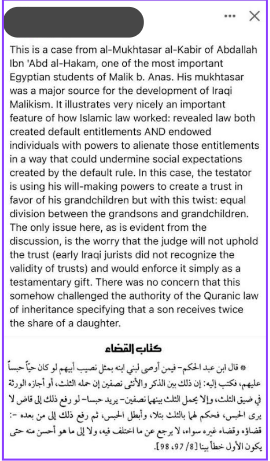
When someone sent me a screenshot of a Facebook post by a noted Muslim academic and expert in Islamic Law. I was perplexed by what the author was trying to do, and felt compelled to address it. I left out his name since it is not necessary.  

According to a hadith, Islamic Inheritance is half of all useful knowledge. My goal is that Islamic Inheritance (known as the “fara’id”) and the wasiyyah should be essential information for Muslim adults.  

This noted Muslim academic highlighted an unnamed “feature” of Islamic law. Where “revealed law both created default entitlements AND endowed individuals with powers to alienate those entitlements in a way that could undermine social expectations created by the default rule.” The academic then says the “testator is using his will-making powers with this twist; equal division between grandsons and grandchildren.” This scholar marveled that “there was no concern that this would somehow challenge the authority of the Quranic law of inheritance specifying that a son receives twice the share of a daughter.”  

It is hard to tell if this academic was blowing smoke or if it demonstrated confusion about what the wasiyyah was. At the very least, readers could be forgiven for reading his prose and becoming more ignorant of Islamic Inheritance and the wasiyyah. So, let’s break this down. 

The Post in Question

If another person can alienate (sell, give away, destroy) something you think is an entitlement, it is not an entitlement. 

  Say Abdullah says to his only son and heir Bilal, “son, I have a million dollars. According to the Quran, you get all of it when I die: “A year later, Abdullah spends a million dollars on a mahar and the gift of a new home for his lovely young bride Bilquis, who ends up divorcing him six months later, but keeps the gifts. When a distraught Abdullah dies soon after, Bilal gets nothing from his now ex-millionaire father.  

Was Bilal ever entitled to a million dollars?  

Of course not. A lovestruck Abdullah had the right to give it all away during his lifetime, never mind if doing so was a good idea. Abdullah alienated his property by gifting it to Bilquis; he did not alienate Bilal’s entitlement. Bilal’s only entitlement is an inheritance from Abdullah if he survives his father. Inheritance means the wealth Abdullah cannot take with him, less his debts and the wasiyyah. 

Debt and Wasiyyah

According to the Quran, specifically 4:12, debt and the wasiyyah are deducted from inheritance. 

So, say, Abdullah never got to meet Bilquis and kept his million dollars until he died. He decides to do an Islamic Estate Plan to follow the mandatory Islamic Rules of Inheritance. Abdullah includes a wasiyyah, giving 20% of his wealth to orphan programs in his native Bangladesh. As I discussed elsewhere, his wasiyyah, should he wish to do one, is limited to ⅓ of his estate.    

Some of Abdullah’s wealth is structured, so the government taxes it after his death. Those taxes are $20,000 (a debt). Abdullah’s burial costs are $10,000.

When Abdullah dies with $1,000,000, his son and only heir, Bilal, receives $770,000.00. Bilal was never entitled to more than that. If Abdullah had a larger wasiyyah, more debt, or spent the money during his lifetime marrying women, Bilal may be entitled to less or nothing. 

Why is there no concern about challenging the Quran?

The academic here goes on to say there was a “twist”- in that the testator gave a wasiyyah to his grandchildren equally among boys and girls. This “twist” goes to “alienate those entitlements” (which, again, is not an actual thing) “in a way that could undermine social expectations created by the default rule.”

The academic explains, “there was no concern this somehow challenged the Quranic law of inheritance specifying that a son receives twice the share of the daughter.”  

Why would a wasiyyah to grandchildren “challenge” the Quran on inheritance to sons and daughters? This proclamation seems incoherent but has confused some. Children have a right to inheritance in Islam. Grandchildren generally do not (obviously, there are situations where they might). Children and grandchildren are different family relationships. Muslims who want to give part of their estate to their grandchildren do it through the wasiyyah or lifetime gifts.  

In our example, Abdullah can give up to ⅓  of his estate as a wasiyyah. So long as he is not violating any rules of the wasiyyah, it is his to bequest as he likes. Say, Abdullah had another son, Hashim, who died five years ago. Six children survived Hashim. Abdullah decided that instead of leaving his wasiyyah to orphan programs in Bangladesh, he would leave 20% of his estate equally to his male and female grandchildren from Hashim, but not his six grandchildren from Bilal, who still have both parents.

Of course, Abdullah can do this. 

Social Expectations. Where?  

Wasiyyah does not come with “social expectations” created by unrelated commands in the Quran.   This claim seems to have no function other than to confuse people. 

The wasiyyah is a simple concept. Muslims have broad but not unlimited latitude in what they can do. The Islamic Rules of Inheritance do not govern this except that the rightful heir cannot be beneficiaries.

To discuss completing an Islamic Estate Plan, you can set up a 15-minute mini-consultation with no obligation by clicking on this link.  

FBAR: How the US Government Can Take Half Your Overseas Money

August 21, 2022 By Ahmed Shaikh

FBARWhy FBAR Matters

Hypothetical: Saqib is a physician in the United States. At age 50, he decides to move back home to his native Pakistan, where he maintains financial accounts of $2,000,000.

At 61, Saqib decides to move back to the United States.

Because Saqib did not report his overseas bank accounts, the government can fine him for half of his money in Pakistan.

It’s common for Muslim families in the United States to have ties overseas and move back and forth. Many also maintain bank accounts overseas to collect rents or profits from business or real estate holdings, slowly disburse charity or zakat once in a while, or just as a place to hold inheritance or gifts.

FBAR Penalties can be steep

If you have financial interests overseas, you need to know about FBAR, or “foreign bank account reporting.” Under US Law (the Bank Secrecy Act), Americans must report their foreign bank accounts. The IRS gets to enforce this with an unforgiving penalty regime. There are two penalties, “willful” and “non-willful.” For non-willful, there is a maximum fine of $10,000. For “willful,” it’s a maximum fine of either $100,000 or half of all the money, whatever is more.


It does not matter if Saqib brought the money to Pakistan with him from the United States, that he inherited it from Pakistan, or if it’s not even his money, only his signing authority. It also does not matter that the account was in an account that earned no interest or income. Not reporting can cause some severe problems.

What “Willful” Means

In law, words often don’t mean what your common sense tells you. If Saqib did not know about the existence of FBAR (because he is an ordinary person), the government might consider his reporting “willful.” The definition of “willful” is evolving and can include people who have no idea they need to report such things. Saqib can be “reckless” about how he conducted his affairs.

Late Reporting

If Saqib has failed to report his bank account for ten years, should he be quiet about it? Should he fess up to the government and plead for mercy? Someone like Saqib should get some professional help. According to the IRS website, they won’t impose a penalty if Saqib is current on his taxes, and the IRS did not previously contact him about his non-compliance.

After Death Reporting

If Saqib dies, he may leave his heirs with a mess and increased exposure to penalties. I have previously written about international assets and how they are often inherently problematic. American heirs of foreign property are often victims of inheritance theft. Extreme FBAR penalty liability only adds to this. For Saqib’s beneficiaries, the penalty can be as much as 35% of the inheritance in some cases.

Affairs in Order

Making sure you have your affairs in order includes Islamic Estate Planning, but you should also consider organizing your finances so that surprises like hefty avoidable fines don’t happen. To discuss planning with Islamic Estate Planning Attorney Ahmed Shaikh, you should schedule a 15-minute mini-consultation over zoom.

  • « Go to Previous Page
  • Page 1
  • Interim pages omitted …
  • Page 3
  • Page 4
  • Page 5
  • Page 6
  • Page 7
  • Interim pages omitted …
  • Page 25
  • Go to Next Page »

Primary Sidebar

“Learn about the fara’id (Islamic Inheritance) and teach it to the people”- Hadith

Get our free Islamic Inheritance Resource Guide, including templates and the know-how you need to start protecting your family.

Download it now.

Recent Posts

  • On Blogging Theology on Charity
  • Private Retirement Plans for Muslims: A California Legal Exemption Strategy
  • Free Loans for Muslim Family Members Have Secret Interest, Not Riba
  • Muslim Burial Challenges
  • Can You Inherit A Masjid? (Why It May be Reasonable to Think So)

© Ahmed Shaikh, Attorney at law. No legal services or advice provided without a written agreement.

  • Home
  • Islamic Estate Planning
  • Blog
  • Library
  • Contact Us